
Interference Simulation#
RadarSimPy can simulate mutual interference: the signal another radar transmits, received directly by the radar under test. This is the dominant impairment wherever several radars share a band, as automotive radars do at 77 GHz and 60 GHz.
The model is not tied to a particular waveform. Both radars are described by
ordinary Transmitter objects, so any waveform that can be configured there —
CW, FMCW, pulsed, phase-coded, stepped frequency, an arbitrary \(f(t)\)
sweep, with or without pulse and fast-time modulation — can act as the victim,
the interferer, or both, and the two need not match.
Interference reaches the victim by a one-way path, so its power falls as \(1/R^2\) against \(1/R^4\) for a target echo. A nearby interferer can therefore rival or exceed genuine returns even at modest transmit power.
Features#
Any waveform, on either side — the victim and the interferer are configured independently, each with its own
fandt,pulses,prp,f_offsethopping, pulse modulation (pulse_amp,pulse_phs) and fast-time modulation (mod_t,amp,phs). See Transmitter and Waveform.Both antenna patterns — the interferer’s transmit pattern toward the victim and the victim’s receive pattern toward the interferer, including their fields of view.
Platform geometry and motion — both radars have their own
location,speed,rotationandrotation_rate, evaluated per sample.Timing — the interferer contributes only while it is actually transmitting: not before its first frame, not between its pulses, and not where its
ampgate is off.Receiver passband — only the part of the interfering signal that falls inside the victim’s baseband bandwidth reaches the output.
A separate output — interference comes back as its own array, next to
basebandandnoise, so it can be analysed, suppressed or combined as needed.
Adding an Interferer#
Describe the interfering radar’s waveform with a
Transmitter.Give it a
Receiver— one is required to build aRadar, but it takes no part in the interference calculation, so any valid settings will do.Place and orient it with
Radar(location=..., rotation=...).Pass it to
sim_radarasinterf.
The configuration below is the one used in the interference example: two 60 GHz radars 30 m apart and facing each other, one down-chirping and one up-chirping across the same 200 MHz, each hopping carrier from chirp to chirp.
import numpy as np
from radarsimpy import Radar, Transmitter, Receiver
from radarsimpy.simulator import sim_radar

# the radar under test: down-chirp, 4 chirps hopping in 90 MHz steps
tx = Transmitter(
    f=[60.6e9, 60.4e9], t=[0, 16e-6], tx_power=25, prp=20e-6, pulses=4,
    f_offset=np.arange(4) * 90e6,
    channels=[{"location": (0, 0, 0), "pulse_phs": np.array([180, 0, 0, 0])}],
)
rx = Receiver(fs=40e6, noise_figure=2, rf_gain=20, load_resistor=500,
              baseband_gain=60, channels=[{"location": (0, 0, 0)}])
radar = Radar(transmitter=tx, receiver=rx)

# the interferer: up-chirp, 8 chirps hopping in 70 MHz steps, 30 m away
int_tx = Transmitter(
    f=[60.4e9, 60.6e9], t=[0, 8e-6], tx_power=15, prp=11e-6, pulses=8,
    f_offset=np.arange(8) * 70e6,
    channels=[{"location": (0, 0.1, 0),
               "pulse_phs": np.array([0, 0, 180, 0, 0, 0, 0, 0])}],
)
int_rx = Receiver(fs=20e6, channels=[{"location": (0, 0.1, 0)}])
interferer = Radar(transmitter=int_tx, receiver=int_rx,
                   location=(30, 0, 0), rotation=(180, 0, 0))

targets = [
    {"location": (30, 0, 0), "speed": (0, 0, 0), "rcs": 10},
    {"location": (20, 1, 0), "speed": (-10, 0, 0), "rcs": 10},
]

result = sim_radar(radar, targets, interf=interferer)
rotation=(180, 0, 0) turns the interferer to face back along −x toward the
victim; see Coordinate Systems for the angle conventions.
Other Waveforms#
Nothing in the setup above is specific to FMCW. Swapping the interferer’s
Transmitter is all it takes to study a different kind of neighbour — here a
CW tone, and the same tone phase-coded at 100 ns per chip, both aimed at the
FMCW victim above:
# a continuous tone in the middle of the victim's band
cw_tx = Transmitter(f=60.5e9, t=100e-6, tx_power=15,
                    channels=[{"location": (0, 0, 0)}])

# the same tone, phase-coded: a PMCW neighbour
chip = 100e-9
mod_t = np.arange(0, 100e-6, chip)
code = np.random.default_rng(0).choice([0, 180], mod_t.size)
pmcw_tx = Transmitter(f=60.5e9, t=100e-6, tx_power=15,
                      channels=[{"location": (0, 0, 0),
                                 "mod_t": mod_t, "phs": code}])

for neighbour_tx in (cw_tx, pmcw_tx):
    neighbour = Radar(transmitter=neighbour_tx, receiver=int_rx,
                      location=(30, 0, 0), rotation=(180, 0, 0))
    result = sim_radar(radar, targets, interf=neighbour)
Pulsed, stepped-frequency or arbitrary-sweep neighbours are built the same way, using the patterns in Transmitter and Waveform. The victim can be any of these too.
Reading the Output#
result["interference"] has the same [channels, pulses, samples] shape
and channel order as baseband and noise. Nothing is pre-mixed, so the
received signal is composed explicitly:
measured = result["baseband"] + result["noise"] + result["interference"]
Keeping the components apart makes common analyses direct:
# signal-to-interference ratio
sir_db = 20 * np.log10(np.abs(result["baseband"]).max()
                       / np.abs(result["interference"]).max())

# which pulses were hit at all, [channels, pulses]
hit = np.abs(result["interference"]).max(axis=-1) > 0

# which samples were hit — the mask a blanking scheme needs
mask = np.abs(result["interference"]) > 0
Targets are optional. sim_radar(radar, [], interf=interferer) returns an
all-zero baseband and a fully populated interference, which is the
quickest way to study the impairment on its own.
How Interference Appears#
For every sample, the simulator works out the victim’s own instantaneous
frequency, \(f_\text{lo}(t)\), and the frequency the interferer was
radiating when the arriving energy left it, \(f_\text{interf}(t)\). Both
come straight from each Transmitter’s f, t and f_offset, so the
rule is the same whatever the two waveforms are. The interferer reaches the
output only while
where \(f_s\) is the victim receiver’s sampling rate fs. For a real
baseband receiver (bb_type="real") the passband is half as wide,
\(f_s / 2\) (Receiver and Baseband).
Inside that window the interference carries the interferer’s own amplitude and
phase modulation — its pulse codes, its amp gate, its fast-time phase code
— and oscillates at the beat frequency
\(f_\text{lo} - f_\text{interf}\). The victim’s own modulation does not
gate reception: its receiver listens for the whole sample window whatever its
transmitter is doing.
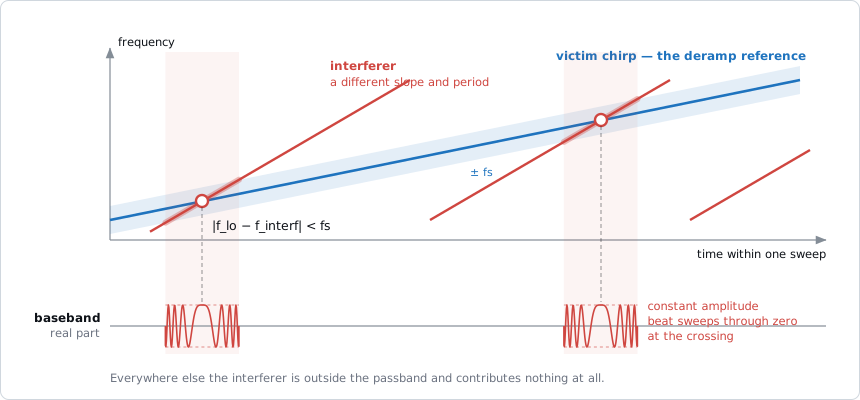
The rule applied to two linear chirps of different slope. Each time the interferer crosses the victim’s passband it leaves a burst in the baseband. The burst has constant amplitude; its beat frequency sweeps through zero at the moment the two chirps cross, so it oscillates quickly at its edges and slowly at its centre.#
What the rule produces depends on how the two frequency curves meet:
Victim and interferer |
What appears in the baseband |
|---|---|
Two chirps, different slopes |
A short burst at each crossing, as in the figure |
Two chirps, the same slope |
Persistent interference across the chirp; it behaves like a false target rather than a transient |
A chirp and a CW tone |
One burst per chirp, when the chirp sweeps past the tone |
Two CW tones |
A steady beat at their frequency offset, or nothing if the offset is beyond the passband |
A phase-coded interferer |
Interference with the interferer’s code imprinted on its phase, which spreads it into a noise-like floor |
A pulsed interferer |
Only the parts of the above that coincide with its pulses |
Arbitrary sweeps |
A burst wherever the two curves come within the passband of each other |
For two linear sweeps, a burst lasts as long as the interferer takes to traverse the passband, \(2 f_s / \lvert k_\text{victim} - k_\text{interf} \rvert\), where \(k\) is the sweep rate and a CW tone has \(k = 0\).
Pulse to pulse, the bursts move, appear and disappear as the two radars’ repetition periods and frequency hops walk past each other.
Several Interferers#
interf accepts a single Radar. For several interferers, simulate each
one separately and sum the interference — contributions add linearly, and
baseband is unaffected by the choice of interferer:
result = sim_radar(radar, targets, interf=interferers[0])
interference = result["interference"]

for other in interferers[1:]:
    interference = interference + sim_radar(radar, [], interf=other)["interference"]

measured = result["baseband"] + result["noise"] + interference
Passing [] as the targets for the additional runs skips work that would
only reproduce the same baseband. The interferers can each use a different
waveform.
Shaping the Scenario#
The same parameters that define each radar control how strongly, how often and where interference lands:
Geometry —
locationsets the path length;rotationpoints each antenna toward or away from the other;speedandrotation_ratemake the coupling evolve through the frame.Antenna patterns —
azimuth_patternandelevation_patternon either side scale the coupling directly, and angles outside a pattern’s span receive nothing (Transmitter and Waveform).Power — the interferer’s
tx_powerscales the interference linearly in dB; the victim’s scales only its own echoes.Waveform — the two frequency curves decide when and for how long they overlap;
f_offsethopping and a staggeredprpchange which pulses collide; the interferer’s pulse and fast-time modulation are carried into the interference.Receiver passband — the victim’s
fssets the passband width, halved for real baseband, and with it how long each overlap lasts.Timing — each radar’s
frame_timealigns or offsets the two transmissions.
Limitations#
Only the direct path is modelled. The interferer’s signal reflecting off targets or the environment before reaching the victim is not included.
One interferer per
sim_radarcall; combine several as shown above.The interferer’s
Receiveris not used.
See Also#
Interference example — the FMCW configuration above as a notebook, with time-frequency and baseband plots
Transmitter and Waveform — configuring CW, FMCW, pulsed, phase-coded and arbitrary waveforms
Radar System Model — why the output components come back separately
Receiver and Baseband —
fsandbb_type, which set the passbandCoordinate Systems — placing and orienting each radar
Noise Simulation — the other additive impairment
Simulator — the
sim_radarreference